


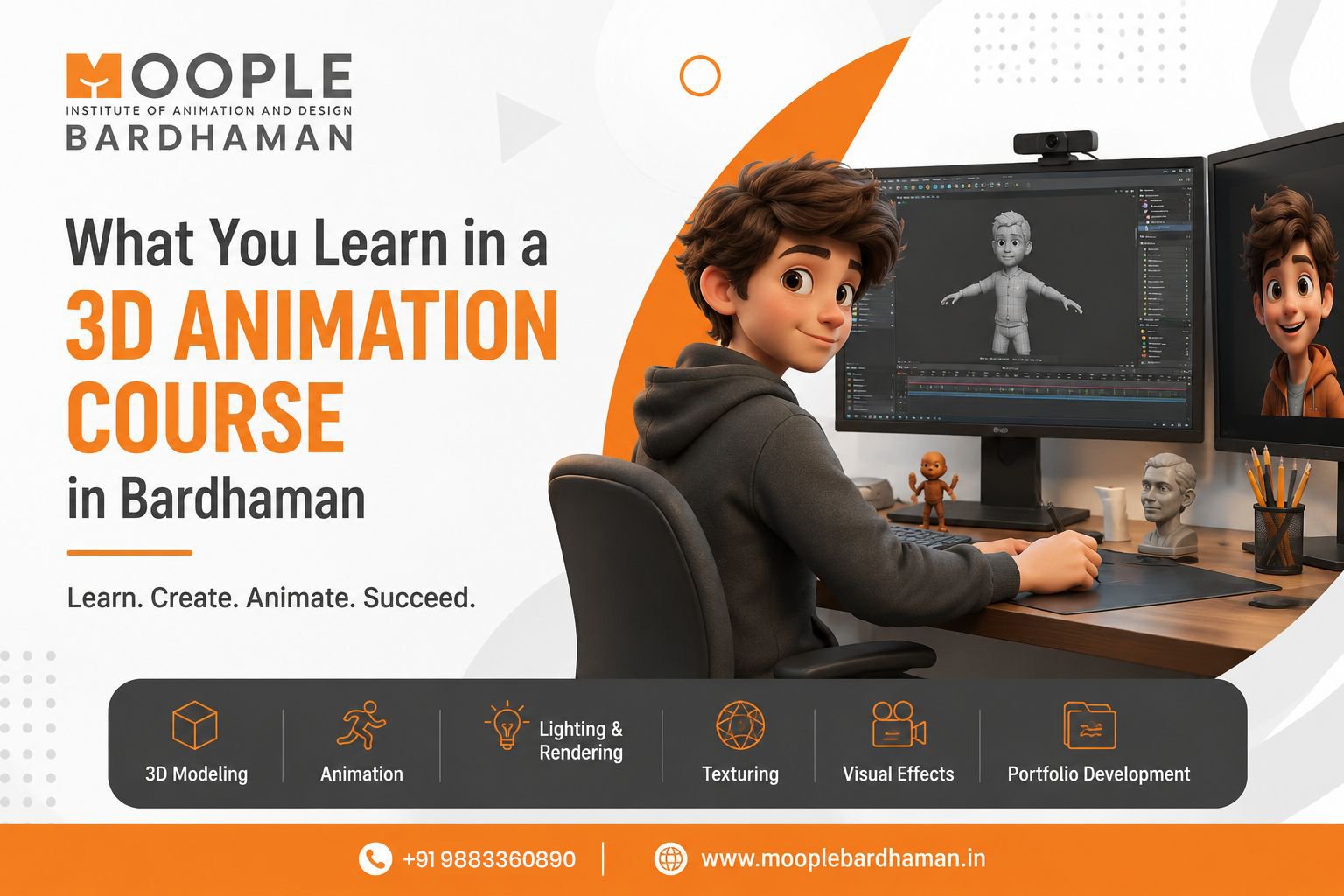
What You Learn in a 3D Animation Course in Bardhaman
The demand for skilled 3D artists is growing across animation, gaming, advertising, films, architecture, product visualization, and digital media. For students who want to turn their creativity into a professional skill, choosing the right 3D Animation Course in Bardhaman can be an important first step.
A structured course helps students understand the complete 3D production process—from creating models and textures to animation, lighting, rendering, and portfolio development. It can also provide practical exposure to industry-standard workflows and creative software.
For students searching for 3D animation courses in Bardhaman, understanding what they will actually learn is essential before choosing an institute or program.
What Is a 3D Animation Course?
A 3D animation course teaches students how to create and animate objects, characters, environments, and visual scenes in a three-dimensional digital space.
Unlike traditional 2D animation, 3D animation involves working with depth, lighting, camera movement, textures, materials, and digital models. Students gradually learn how different elements work together to create realistic or stylized animated content.
A comprehensive course generally combines 3D modeling and animation training in Bardhaman with practical projects, creative assignments, software training, and portfolio development.
What Do You Learn in a 3D Animation Course in Bardhaman?
1. Fundamentals of 3D Design
The first stage usually focuses on understanding the fundamentals of 3D design. Students learn about shapes, proportions, perspective, composition, and spatial relationships.
These basics help beginners understand how real-world objects can be recreated digitally. Strong fundamentals are particularly important before moving into advanced modeling and animation techniques.
2. 3D Modeling
3D modeling is one of the core skills taught in a 3D Animation Course in Bardhaman.
Students learn how to create digital models of:
- Characters
- Buildings
- Products
- Vehicles
- Props
- Environments
- Other creative assets
They may learn different modeling techniques, including polygon modeling and other professional workflows. Students also learn how topology and geometry affect the appearance and animation of a model.
3. Texturing and Materials
A 3D model can look basic without appropriate textures and materials.
Students learn how to apply colors, surface details, patterns, reflections, roughness, and other material properties to their models. This helps them create surfaces such as metal, glass, wood, plastic, fabric, and skin.
Understanding materials is useful for creating realistic product visuals, characters, environments, and cinematic scenes.
4. Character Design and Modeling
Character creation is an important part of many animation programs.
Students can learn how to develop character concepts and convert them into 3D models. Depending on the course curriculum, training may include facial features, body proportions, clothing, accessories, and other character elements.
This knowledge can support future careers in animation, gaming, advertising, and visual storytelling.
5. Rigging
A 3D character needs a digital skeleton or control system before it can be animated efficiently.
Rigging teaches students how to prepare characters and other objects for animation. They learn how controls, joints, and digital skeletons work together to create movement.
Good rigging is essential for producing natural and controllable character animation.
6. 3D Animation
Animation brings a static model to life.
Students learn concepts such as:
- Keyframes
- Timing
- Spacing
- Motion
- Character movement
- Camera animation
- Object animation
They also learn how to create believable movements and communicate actions through animation.
The goal is not simply to move an object but to understand how movement, timing, and storytelling influence the viewer.
7. Lighting and Rendering
Lighting can dramatically change the appearance and mood of a 3D scene.
Students learn how to use different types of lights, shadows, highlights, and environmental lighting. They also learn rendering concepts that help convert a 3D scene into a final visual output.
These skills are useful for animation films, advertisements, product visualization, architectural presentations, and other digital media projects.
8. Camera and Composition
A 3D artist also needs to understand how a scene is presented to the audience.
Students learn camera positioning, framing, perspective, camera movement, and composition. These techniques help them create visually engaging shots and communicate a story more effectively.
Understanding cinematography can be particularly useful for students interested in film, advertising, gaming, and animation production.
9. Visual Effects and Post-Production
Depending on the curriculum, students may also receive an introduction to visual effects and post-production.
This can include compositing, color correction, visual enhancement, and combining different visual elements into a finished sequence.
Learning how animation interacts with other digital production techniques can broaden a student's career possibilities.
10. Portfolio Development
Learning software alone is not enough to start a professional creative career. Students also need work that demonstrates their skills.
A good animation program should encourage students to develop projects that can become part of a professional portfolio.
A portfolio may include:
- 3D models
- Character designs
- Animated sequences
- Product visualizations
- Environment designs
- Short animation projects
A strong portfolio can help students demonstrate practical abilities during internships, interviews, freelance opportunities, or further studies.
Career Opportunities After 3D Animation Training
After completing a 3D Animation Course in Bardhaman, students can explore different creative career paths depending on their skills and specialization.
Potential roles include:
- 3D Animator
- 3D Modeler
- Character Artist
- Texture Artist
- Lighting Artist
- Rendering Artist
- 3D Visualizer
- Game Artist
- Motion Graphics Artist
- VFX Artist
Opportunities can exist across animation studios, gaming companies, advertising agencies, production houses, architectural visualization companies, and freelance projects.
Students should remember that career growth depends on practical skills, portfolio quality, specialization, software knowledge, creativity, and continuous learning.
How to Choose the Right Animation Institute
When searching for the Best animation institute in Bardhaman, students should evaluate more than course fees.
Consider factors such as:
- Course curriculum and modules
- Practical project opportunities
- Software and technical training
- Faculty experience
- Portfolio development
- Industry-oriented assignments
- Classroom and learning facilities
- Internship or career guidance
- Student reviews and previous work
- Course duration and learning structure
Students searching for an “Animation institute near me” should also visit the institute, understand the curriculum, speak with instructors if possible, and review student portfolios before making a decision.
Why Practical Learning Matters
3D animation is a skill-based field. Watching tutorials can introduce students to software, but consistent hands-on practice is what develops professional ability.
A structured 3D Animation Course in Bardhaman can help learners progress from basic concepts to complete projects while receiving guidance during the learning process.
Students should ideally practice regularly, experiment with different styles, study professional animation, and continuously improve their portfolios.
Start Building Your 3D Animation Skills
3D animation combines creativity, technology, storytelling, and design. From modeling and texturing to rigging, animation, lighting, rendering, and portfolio development, students can build a wide range of practical skills through structured training.
For students considering 3D animation courses in Bardhaman, the right learning environment can provide a strong foundation for exploring careers in animation, gaming, VFX, advertising, visualization, and digital media.
Moople Bardhaman can be considered by students exploring professional animation and multimedia education in the region. Before enrolling, compare the curriculum, practical training, faculty, projects, and career support to choose a program that matches your goals.
FAQs
1. What do you learn in a 3D Animation Course in Bardhaman?
Students typically learn 3D modeling, texturing, materials, rigging, animation, lighting, rendering, camera techniques, and portfolio development.
2. Who can join a 3D Animation Course in Bardhaman?
Students, beginners, creative professionals, and anyone interested in animation and digital design can explore suitable 3D animation programs based on their educational background and course eligibility.
3. Is 3D animation a good career option?
Yes. 3D animation skills can be applied across gaming, films, advertising, VFX, product visualization, architecture, and digital content production.
4. What software is used for 3D animation?
Software varies by institute and curriculum. Professional training may include tools for modeling, texturing, rigging, animation, rendering, and compositing.
5. Do I need drawing skills to learn 3D animation?
Advanced drawing skills are not always required to start. However, understanding proportions, shapes, anatomy, perspective, and visual composition can be highly beneficial.
6. Can beginners learn 3D animation?
Yes. Beginners can start with fundamental concepts and gradually progress to modeling, animation, lighting, rendering, and advanced projects.
7. What jobs can I get after 3D animation training?
Depending on specialization and portfolio quality, students can pursue roles such as 3D animator, modeler, character artist, lighting artist, 3D visualizer, game artist, or VFX artist.
8. How important is a 3D animation portfolio?
A portfolio is extremely important because it provides practical evidence of a student's creativity, technical ability, and understanding of the production process.
9. How do I choose the best animation institute in Bardhaman?
Compare the curriculum, practical training, faculty, software training, projects, portfolio development, facilities, student work, and career guidance before enrolling.
10. Can I build a career in gaming after a 3D animation course?
Yes. 3D modeling, character creation, texturing, lighting, and animation skills can be useful for several roles within the gaming industry.