




Static vs Dynamic Websites: Differences, Examples and Usage
A website is usually the first way a business connects with new customers. Not every website works the same. Some just show fixed information, while others update content or react to what users do. If you understand how static and dynamic websites work, you can figure out which type fits your needs—whether you’re running a business, studying, or planning to build websites yourself.
If you’re thinking about taking a Website Design Course in Bardhaman, honestly, getting clear on the basics of static versus dynamic sites is where you start. Each option has its own perks, and picking the right one really comes down to what your site needs to do, your budget, and how much you want it to grow in the future.
What Is a Static Website?
A static website is pretty straightforward. The content stays the same unless someone—usually the admin—goes in and changes the files. These sites are built with HTML, CSS, and sometimes a bit of JavaScript like programming languages. When you visit a static page, your browser grabs the files directly from the server and shows them as they are. No fancy databases or server-side code needed. It’s simple and reliable.
Examples of Static Websites
Static websites are suitable for cases where information does not change very often. Examples of projects that benefit from being static, and their key content, include the following:
- Personal portfolio: display of completed work, skills, and contact details
- Business website: services, business hours, and location
- Event landing page: schedule, venue, and registration
- Digital brochure: details about a company, product, or service
A freelance graphic designer, for instance, could utilize a static website to build a portfolio with completed work, a short introduction, and contact details. If the content changes rarely, this type of page is a useful solution.
Advantages of Static Websites
Static websites are easy to use and it takes less time to load if properly optimized. A static site’s relative simplicity usually means that they host fewer components that require maintenance. However, frequent updates or changes can become tedious, and a static site cannot provide a user account, inventory, dashboard, or similar features.
What Is a Dynamic Website?
A dynamic website is a website that changes its content, layout, or data in real time for each visitor rather than showing the exact same fixed page to everyone. Unlike a static website, where the content usually remains the same for every visitor, a dynamic website can offer a more personalized and interactive experience.
These websites use programming languages, databases, and technologies to display relevant information and respond to user actions. For example, when you log in to an account, search for a product, or check your order status, the website retrieves the necessary information and displays it according to your needs.
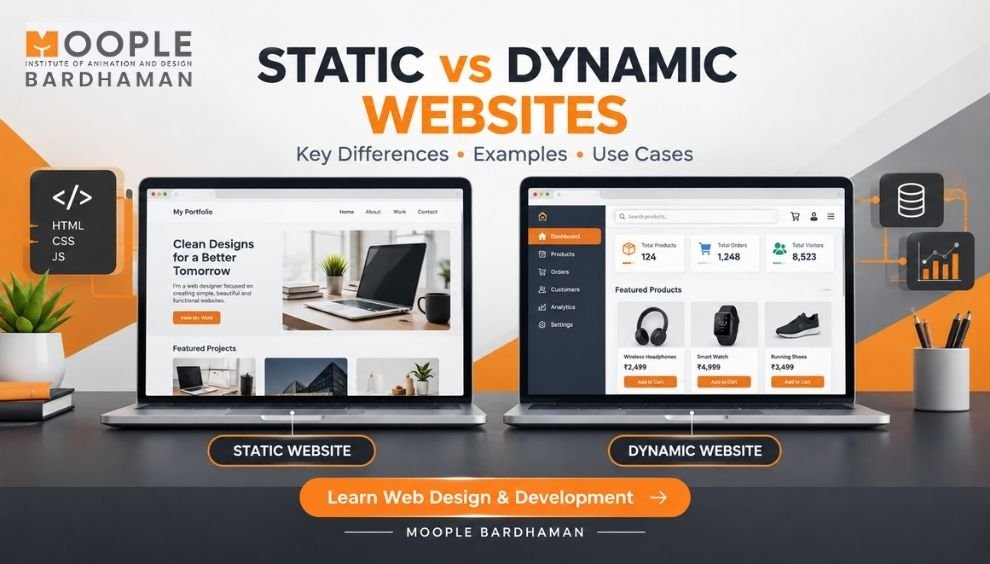
The main difference between a static and a dynamic website is how the content is delivered. A static website generally displays pre-created pages, while a dynamic website can generate or update pages depending on the user's actions, available data, or other conditions.
Advantages of Dynamic Websites
Dynamic websites have more complex features and frequent content updates while providing a personalized experience. They can also support database-powered information and offer more potential options for a growing business. At the same time, their development and maintenance are usually more critical and require more expertise, time, and resources than a static page would.
Static vs Dynamic Websites: Key Differences
The main difference between static and dynamic websites lies in their content and technologies. While static web pages are mostly fixed, dynamic pages can update themselves or change based on specific data. The key differences are summarized in the table below.
|
Feature |
Static Website |
Dynamic Website |
|
Content |
Mostly fixed |
Can change based on data or user actions |
|
Technologies |
HTML, CSS, JavaScript |
HTML, CSS, JavaScript, server-side languages, APIs, and databases as needed |
|
Loading speed |
Often fast with minimal processing |
Depends on application complexity and optimization |
|
Development cost |
Often lower for simple projects |
Can be higher for complex functionality |
|
Content updates |
Usually require file edits or a deployment workflow |
Often managed through an admin panel or database |
|
User interaction |
Basic interactions are common |
Supports more complex interactions |
|
Security |
Smaller server-side attack surface in simple setups |
More components may require security controls |
|
Best suited for |
Portfolios, brochures, landing pages |
Online stores, portals, booking systems |
These are general differences, as a poorly optimized static page can be slow, and a complex dynamic page would usually be optimized to be fast. The appropriate website would be chosen based on what the website is supposed to do.
Which Website Type Is Better for Your Business?
The right type of website will be chosen based on its required features. A static website can be used for a simple online presence with a small content and a smaller budget. It can also be a good place to start for freelancers, local service providers, personal portfolio, and small business owners. For instance, a local photography studio’s website may only need to display its work, services, and contact details. Meanwhile, a dynamic website is the superior choice in all cases that involve regular content publishing, user accounts, payments, booking management, database information, or similar features. An educational institute’s website that needs to display courses, accept student applications, and have a manager area, would want dynamic. Before choosing a particular type of website, keep in mind both your immediate requirements and future plans as well. Extra features can increase costs, while a website that is too simple may not meet your future needs.
Can a Website Be Both Static and Dynamic?
Websites can be a mix of static and dynamic pages or utilize modern solutions that give the best of both in some cases. A company’s website, for instance, may have static About and Contact pages while having dynamic blog, customer testimonial, and product listing sections. Similarly, modern frameworks and content management systems can allow developers to pre-generate pages for speed while utilizing dynamic data when needed.
Skills Needed to Build Static and Dynamic Websites
Having an understanding of static and dynamic websites is useful for anybody who is just starting out in web development.
To build static websites, learners will need to gain knowledge of HTML and CSS to structure and style their site, responsive design to make it display correctly on all devices, and JavaScript to add interactive elements. To build dynamic websites, meanwhile, students will have to learn additional topics such as server-side programming, databases, APIs, form processing, authentication, and security.
A proper learning path for building websites will usually begin with the basics of website structure and style, followed by responsive design and JavaScript, and then progress to back-end development and databases. Completing projects such as a personal portfolio, business website, and a content management system project can also help learners apply their knowledge to meet real-world requirements.
Learners who are considering Web Development Training, for instance, will greatly benefit from the practical nature of the projects they will complete as a part of their courses, which will allow them to understand the underlying features and requirements of the websites they are working on.
Learn Website Design and Development Skills with Moople Bardhaman
Choosing between a static and a dynamic website is only a part of creating a qualified web professional. Having a general understanding of the user experience, responsive design, coding, performance, and practical applications is essential for an aspiring web developer or designer, and it can help guide their learning and experience. Students who are interested in a Website Design Course in Bardhaman can utilize the discussed distinctions to choose their learning path and long-term goals. Before enrolling, make sure to ask about the syllabus, practical projects, technologies, and portfolio opportunities to ensure the best fit.
Start Your Web Development Learning Journey Today
Static and dynamic websites serve very different purposes. Static websites are ideal in cases where a simple and speedy page is needed, while dynamic sites are better in all other cases where a database or application is required to power the features the site offers. It is up to the future web developer to determine which one fits their goals and capabilities better.
Whether you are considering a business website or starting your web development learning journey, the distinctions between the two types of websites will help you determine the most suitable type for your needs and the technologies you will need to learn.
Ready to start learning? Explore the website design and development learning opportunities at Moople Bardhaman and take the next step towards building your practical web development skills.
FAQs
1. What is the main difference between static and dynamic websites?
A static website displays mostly fixed content, while a dynamic website can update content time to time based on user actions, database information, or application logic.
2. Which is better: a static website or a dynamic website?
Neither is universally better. Static websites suit portfolios and simple business pages, while dynamic websites are ideal for e-commerce stores, educational portals, booking systems, and other interactive platforms. Both are good according to needs.
3. Are static websites faster than dynamic websites?
Static websites often load quickly because they require less server-side processing. However, well-optimized dynamic websites can also deliver excellent performance.
4. Is HTML and CSS enough to build a static website?
HTML and CSS are enough to create a static website. JavaScript can be added to provide interactive features such as menus, sliders, and form validation.
5. Which programming languages are used to develop dynamic websites?
Dynamic websites may use JavaScript, PHP, Python, or other server-side technologies, along with databases such as MySQL or PostgreSQL. The exact tools depend on the website’s requirements.
6. What skills are required to learn website design and development?
Learners should understand HTML, CSS, responsive design, JavaScript, and user experience fundamentals. Learning server-side programming, databases, APIs, and website security can help them progress into dynamic website development.
7. Where can I learn website design and development in Bardhaman?
Students interested in a Website Design Course in Bardhaman can explore learning opportunities at Moople Bardhaman through mooplebardhaman.in Before enrolling, check the syllabus, practical projects, technologies covered, and portfolio-building opportunities.