



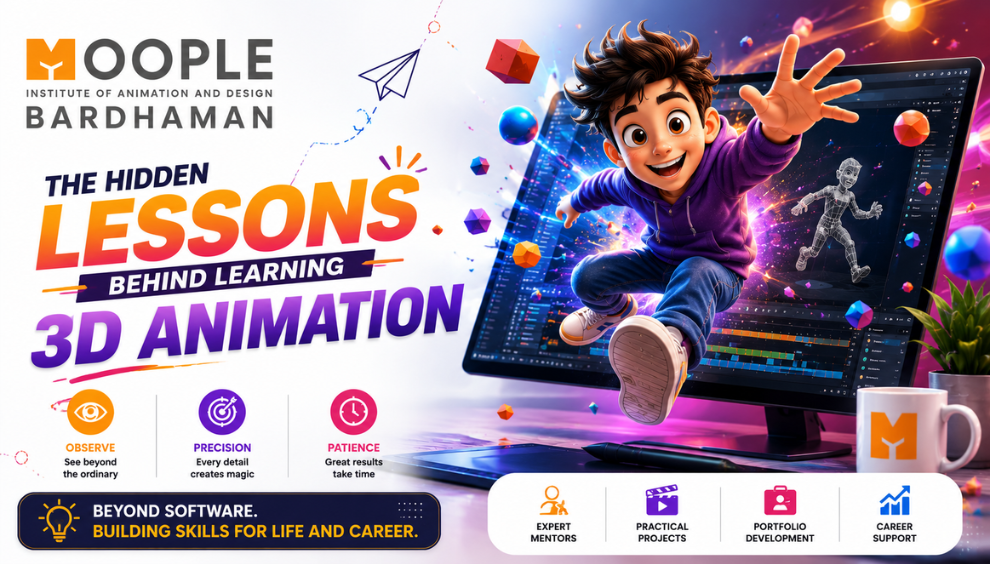
The Hidden Lessons Behind Learning 3D Animation
In today's fast-evolving creative industry, 3D animation is often viewed as a technical skill used in films, gaming, advertising, and digital media. However, the benefits of learning 3D animation go far beyond mastering software or creating impressive visual effects. At Moople Bardhaman, students discover that animation training develops essential life skills that shape their careers and personal growth.
Whether you're pursuing a 3D Animation Course, exploring creative career options after 12th, or looking for a professional animation institute in Bardhaman, understanding these hidden lessons can help you appreciate the true value of animation education.
Why 3D Animation Is More Than Just Learning Software
Many students join an animation course expecting to learn industry-standard tools and create digital characters. While software proficiency is important, successful animators understand that technology is only a medium for expressing ideas. The real learning happens through the process of planning, creating, revising, and improving every project.
Developing a Creative Mindset
Animation requires students to think beyond what they see. They must imagine movements, emotions, and interactions before bringing them to life on screen. This encourages creative thinking and helps students develop innovative problem-solving abilities.
For example, when creating a character animation, students must understand how body language communicates emotions. A simple walk cycle can teach timing, storytelling, and human behavior. These experiences help learners become better observers and more effective communicators.
At Moople Bardhaman, project-based learning ensures students actively apply these concepts rather than simply memorizing software functions. As a result, they build skills that remain valuable throughout their careers.
Learning Patience Through Every Frame
One of the most valuable lessons hidden within animation training is patience. Creating high-quality 3D animation takes time, attention, and continuous refinement.
Understanding the Value of Iteration
Professional animation projects rarely succeed on the first attempt. Students often revise character models, lighting setups, textures, and animation sequences multiple times before achieving the desired result.
This process teaches an important lesson: excellence comes through improvement, not perfection on the first try.
For instance, a student creating a short animation scene may spend hours adjusting character movements to make them appear natural. Although challenging, this experience builds persistence and resilience—qualities highly valued in every profession.
Students enrolled in a multimedia course in Bardhaman often discover that patience developed through animation projects improves their ability to tackle complex challenges in academics, careers, and everyday life.
How 3D Animation Improves Observation Skills
Great animation begins with observation. Before animators create realistic movements, they must understand how people, animals, and objects behave in the real world.
Seeing Details Others Miss
Animation students learn to study facial expressions, walking patterns, gestures, and environmental interactions. This habit of careful observation strengthens their attention to detail.
For example, observing how sunlight affects different surfaces helps students create realistic lighting and shadows. Watching human interactions helps them animate believable emotions and reactions.
These skills are useful beyond animation. Improved observation enhances creativity, communication, and problem-solving abilities across multiple industries.
At Moople Bardhaman, students are encouraged to explore the world around them and use real-life references to create authentic animations. This practical approach bridges the gap between imagination and reality.
Precision and Attention to Detail Build Professionalism
In animation, small details often determine the success of a project. A slight adjustment in timing, lighting, or camera angle can dramatically improve the final result.
Why Precision Matters
Students quickly learn that professional-quality work requires accuracy. Whether rigging a character, creating textures, or setting up visual effects, precision plays a crucial role in achieving realistic outcomes.
This attention to detail gradually becomes a habit. Students begin approaching assignments, presentations, and creative projects with greater discipline and professionalism.
Employers frequently seek candidates who can manage details effectively and deliver consistent quality. By learning 3D animation, students naturally develop these workplace-ready skills.
This is one reason why graduates from a reputable animation training institute often adapt quickly to professional environments.
Building Confidence Through Creative Challenges
Every animation project presents unique challenges. Students must learn new techniques, overcome technical obstacles, and solve creative problems independently.
Growth Through Project-Based Learning
When students successfully complete a complex project, they gain confidence in their abilities. This confidence grows with every milestone achieved, from creating their first 3D model to producing a complete animation sequence.
Project-based learning encourages experimentation and innovation. Students learn that mistakes are part of the creative process and that every challenge presents an opportunity to improve.
At Moople Bardhaman, students work on practical projects that simulate real-world industry workflows. This hands-on experience helps them develop confidence and prepares them for future career opportunities in animation, VFX, graphic design, gaming, and digital media.
How Animation Prepares Students for Future Careers
The lessons learned through animation extend far beyond technical expertise. Employers increasingly value professionals who can think creatively, collaborate effectively, and solve problems independently.
Transferable Skills for Long-Term Success
Animation training develops several transferable skills, including:
- Critical thinking
- Communication
- Team collaboration
- Time management
- Problem-solving
- Adaptability
- Creative storytelling
These abilities are relevant across multiple industries, including advertising, gaming, digital marketing, film production, web design, and content creation.
Students who complete a 3D animation course in Bardhaman often discover that the skills they gain help them succeed in various professional environments, whether they pursue studio jobs, freelancing, or entrepreneurship.
Conclusion
The hidden lessons behind learning 3D animation go far beyond software and technical knowledge. Students develop patience, precision, observation skills, confidence, creativity, and professional discipline—qualities that contribute to long-term success in any career.
At Moople Bardhaman, we believe that animation education should prepare students not only for jobs but also for lifelong growth. Through practical training, real-world projects, and industry-oriented learning, students gain valuable skills that shape both their professional and personal journeys.
If you're looking for the best animation institute in Bardhaman to begin your creative career, exploring the world of 3D animation may be the first step toward discovering your full potential.
FAQs
1. What are the hidden lessons students learn through 3D Animation?
Beyond software skills, students learn patience, observation, creativity, problem-solving, and attention to detail through every animation project.
2. Why is patience important in 3D Animation?
Creating realistic animations takes multiple revisions and refinements. This process teaches students to stay focused and committed to quality work.
3. How does 3D Animation improve observation skills?
Animators study real-life movements, expressions, and environments to create believable scenes, helping them become better observers.
4. Can learning 3D Animation improve creativity?
Yes. Students constantly develop ideas, solve visual challenges, and create stories, which naturally strengthens creative thinking.
5. What makes 3D Animation different from other creative fields?
3D animation combines art, storytelling, technology, and problem-solving, making it one of the most versatile creative disciplines.
6. Do students learn skills that are useful outside the animation industry?
Absolutely. Time management, teamwork, communication, critical thinking, and adaptability are valuable in almost every profession.
7. How do practical projects help animation students grow?
Projects provide hands-on experience, build confidence, and help students understand how professional creative workflows operate.
8. Why is attention to detail important in 3D Animation?
Small details such as timing, lighting, and movement can significantly impact the quality and realism of an animation.
9. How does Moople Bardhaman help students learn beyond the classroom?
At Moople Bardhaman, students gain practical experience through project-based learning, portfolio development, creative workshops, and industry-oriented training.
10. Why do students choose Moople Bardhaman for Animation training?
Students choose Moople Bardhaman because of its hands-on learning approach, experienced mentors, real-world projects, and focus on building career-ready creative skills.