



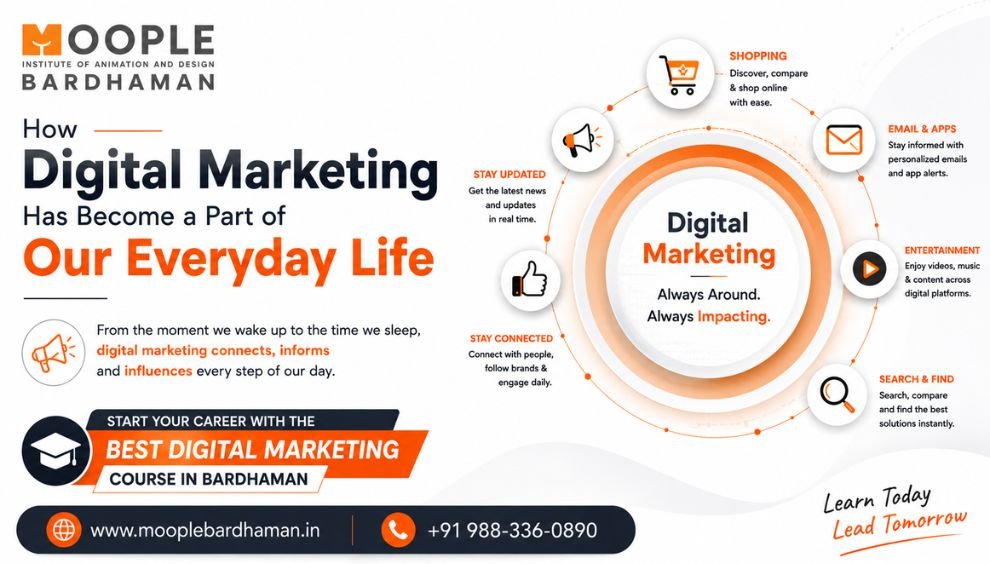
How Digital Marketing Has Become a Part of Our Everyday Life
Have you ever searched for a course on Google and then noticed similar advertisements on Instagram or YouTube? Or searched for a restaurant nearby and suddenly started seeing food-related offers on your mobile?
You may also have noticed astrology services, healthcare information, online courses, shopping offers, travel packages, real estate projects and local businesses appearing on your screen every day.
This is not simply a coincidence. Digital marketing has become a major part of our everyday digital experience.
Today, we search, watch, compare, communicate, learn and even make purchasing decisions online. Businesses have also changed the way they reach people. Instead of depending only on newspapers, banners, television or traditional advertising, businesses now use SEO, social media marketing, Google Ads, content marketing, websites, email marketing and other digital channels to connect with their audiences.
For learners who are thinking about building modern career skills, understanding how digital marketing works in everyday life is an excellent place to begin.
What Is Digital Marketing?
Digital marketing means promoting a business, product, service, idea or brand through digital channels.
These channels can include:
Search engines like Google
Social media platforms
Websites and blogs
YouTube and video platforms
Mobile applications
Online advertising platforms
Content platforms
But digital marketing is much more than simply showing advertisements.
It involves understanding what people are looking for, how they search for information, what content attracts their attention, how businesses communicate with them and what encourages them to take action.
For example, when someone searches for “digital marketing course in Bardhaman”, several digital marketing activities may be involved in helping an institute appear in front of that learner.
SEO can help the website appear in search results. Content can answer the learner's questions. Social media can create awareness. Google Ads can provide paid visibility. A well-designed website can provide course information and encourage the learner to enquire.
This entire process is part of the digital marketing ecosystem.
Digital Marketing Is Already Around You
Many people think digital marketing is something used only by large companies or professional marketing agencies.
In reality, it is much closer to us.
Think about your normal day.
You wake up and check your phone. You open Instagram, YouTube or Facebook. You search something on Google. You watch a video. You check a product online. You look for a restaurant. You search for a doctor. You explore a course.
During many of these activities, you are interacting with digital marketing.
Searching for Something on Google
Suppose you want to learn a new skill.
You search:
“Best digital marketing course in Bardhaman.”
Google provides a list of websites, business profiles, advertisements and other information.
Behind this visibility, businesses may be using different digital marketing techniques.
SEO helps websites improve their organic visibility in search engines.
Google Ads can help businesses appear in paid search placements.
Google Business Profile optimization can help local businesses become more visible to people searching nearby.
Content marketing can provide useful answers to potential customers.
As a learner, understanding this process helps you realize that every search result has a story behind it.
Why Do We See Advertisements Related to Our Interests?
Have you ever searched for something and later noticed advertisements related to it?
For example, imagine that you are researching a digital marketing course.
You may visit a website, watch digital marketing videos, search related terms or interact with educational content. Later, you might encounter advertisements or content related to digital marketing on different platforms.
Digital advertising platforms can use available signals such as search activity, interactions, audience characteristics and browsing or platform data, depending on the platform and its privacy settings, to help advertisers reach relevant audiences.
This is one reason businesses spend so much time understanding audience behaviour and customer intent.
Digital marketers need to understand not only:
“What are we selling?”
but also:
“Who might need it?”
“What are they searching for?”
“Where do they spend time online?”
“What information do they need before making a decision?”
These questions are at the heart of digital marketing.
From Astrology to Healthcare: Digital Marketing Is Everywhere
One of the most interesting things about digital marketing is how widely it is used.
Take astrology as an example.
Someone interested in astrology may search for horoscopes, consultations, astrology courses or related services online. Astrology businesses can use websites, social media, videos, SEO and online advertising to reach interested audiences.
Now think about healthcare.
People search for doctors, clinics, hospitals, health information, diagnostic services and wellness solutions online. Healthcare organizations can use websites, search visibility, educational content and social media to provide information and connect with audiences.
Education is another major example.
Students search for:
Courses
Colleges
Training institutes
Career options
Online classes
Skill-development programs
Educational organizations use digital platforms to provide information and attract prospective students.
The same concept applies to many other areas, including:
Restaurants
Real estate
E-commerce
Travel
Fitness
Fashion
Banking
Agriculture
Technology
Entertainment
Local businesses
This shows an important reality:
Digital marketing is not limited to one particular industry. It has become a common way for businesses and organizations to communicate with people.
How Does a Business Reach You Online?
Imagine a new business opening in your city.
Earlier, the owner might depend mainly on a physical signboard, newspaper advertisement, flyers or word-of-mouth promotion.
Today, the business can create a website, Google Business Profile and social media presence.
It can publish useful content, optimize its website for search engines and run online advertisements.
Now imagine someone searching:
“Best service near me.”
The business may have an opportunity to appear in front of that potential customer.
This is one of the biggest changes brought by digital marketing.
A business no longer has to communicate only with people who physically pass by its location.
It can potentially reach people who are actively searching for its products or services online.
How Information Spreads So Quickly
Another major reason digital marketing has become powerful is speed.
A traditional advertisement may require considerable time and resources to distribute.
Digital content can be published within minutes and potentially reach a large audience.
For example, a business can:
Create a short video.
Publish it on social media.
Share it with its audience.
Run an advertisement around the content.
Receive comments and interactions.
Analyze the response.
Improve the next campaign.
This creates a continuous cycle of content → audience → interaction → data → improvement.
That is why digital marketing is not simply about putting an advertisement online.
It is about understanding what happens before, during and after people see that advertisement.
Digital Marketing Is More Than Advertising
When people hear “digital marketing,” they often immediately think about advertisements.
But digital marketing includes many different areas.
SEO
Helps businesses improve their visibility in search engines.
Social Media Marketing
Helps brands communicate and engage with audiences on social platforms.
Google Ads and PPC
Allows businesses to use paid advertising to reach targeted audiences.
Content Marketing
Uses useful and relevant content to attract and educate audiences.
Email Marketing
Helps businesses communicate directly with subscribers and customers.
Analytics
Helps marketers understand what is working and what needs improvement.
Website Marketing
A website provides information, builds credibility and can turn visitors into enquiries or customers.
All these areas work together.
Why Should Learners Understand This?
This is where digital marketing becomes interesting for students and beginners.
You are already experiencing digital marketing as a user.
Every day, you see search results, social media posts, videos, recommendations and advertisements.
Learning digital marketing means going one step further.
Instead of only asking:
“Why am I seeing this?”
you can begin asking:
“How did this business reach me?”
Instead of simply watching a promotional video, you can understand:
“Why was this content created?”
Instead of only seeing a business on Google, you can understand:
“What SEO or local marketing strategy helped it become visible?”
That change in perspective is the beginning of becoming a digital marketer.
Digital Marketing Is Becoming an Important Modern Skill
Businesses are increasingly using digital channels to communicate with their audiences. As a result, people who understand digital platforms, online customer behaviour, content, search, advertising and analytics can bring valuable skills to modern workplaces.
This is why digital marketing skills can be useful for students, graduates, freelancers, entrepreneurs and working professionals.
You do not need to wait until you become a business owner to understand digital marketing.
You are already living in the digital environment.
The next step is learning how it works.
What Comes Next?
We have seen how digital marketing has become part of our everyday life—from the Google searches we make to the social media content we watch and the advertisements we encounter.
But there is another important question:
Who creates these campaigns, what skills do they need, and how can a learner turn this knowledge into a career?
That is where learning digital marketing becomes more interesting.
From Digital User to Digital Marketer
Most of us use digital platforms every day.
We search on Google, watch videos, follow social media pages, compare products and interact with online content.
A digital marketer looks at the same activities differently.
When a normal user sees an advertisement, a digital marketer may ask:
Who is the target audience?
Why was this advertisement created?
Which platform is being used?
What keywords are involved?
Why does this content attract attention?
How many people clicked on it?
Did those clicks generate enquiries or sales?
How can the campaign be improved?
This is the difference between using digital platforms and understanding digital marketing.
Learning digital marketing allows you to look behind the screen and understand the strategies that businesses use to reach people.
What Skills Are Behind Digital Marketing?
Digital marketing is a broad field. It is not one single skill.
A professional digital marketing course usually introduces learners to several interconnected areas.
1. Search Engine Optimization – SEO
When you search for something on Google, you usually see a list of websites and other results.
But why does one website appear before another?
One important factor is Search Engine Optimization (SEO).
SEO involves improving websites and content so that they can become more useful, relevant and visible in search engines.
Learners can explore areas such as:
Keyword research
On-page SEO
Technical SEO
Content optimization
Local SEO
Link building
Search performance analysis
For example, when someone searches “digital marketing course in Bardhaman,” SEO can play a role in how relevant educational websites become visible in organic search results.
Learning SEO helps students understand how search engines and websites interact.
2. Social Media Marketing
Think about how much time people spend on platforms such as Instagram, Facebook, YouTube and other social networks.
Businesses know that their potential customers are already spending time there.
Social media marketing helps businesses communicate with these audiences through:
Posts
Reels
Videos
Stories
Campaigns
Community engagement
Paid advertisements
But successful social media marketing requires more than simply uploading content.
A marketer needs to understand:
Audience + Content + Platform + Timing + Strategy + Measurement
This makes social media marketing an interesting and creative area for learners.
3. Google Ads and Online Advertising
Have you noticed sponsored results when searching on Google?
These can be part of Google Ads and paid search marketing.
Businesses can create campaigns designed to reach people who are searching for particular products, services or solutions.
For example, someone searching for:
“digital marketing training in Bardhaman”
may encounter paid advertisements from relevant businesses.
Learning Google Ads introduces students to concepts such as:
Keywords
Search intent
Ad copy
Targeting
Bidding
Campaign structure
Landing pages
Conversion tracking
This helps learners understand how businesses can reach potential customers when they are actively looking for something.
4. Content Marketing
Why do businesses publish blogs, videos, guides, social media posts and educational content?
Because useful information can attract attention and build trust.
Imagine a student searching:
“What is digital marketing?”
An educational article that clearly answers this question can introduce that student to a brand.
That is where content marketing becomes important.
Content can:
Educate
Inform
Answer questions
Build awareness
Generate traffic
Support SEO
Encourage engagement
Help customers make decisions
Learning content marketing can therefore help students understand how valuable information becomes part of a business's marketing strategy.
5. Website and Landing Page Skills
A digital campaign often leads people somewhere.
That destination may be:
A website
A product page
A course page
A landing page
A contact form
Imagine clicking an advertisement for a digital marketing course.
If the landing page is confusing, slow or difficult to navigate, you may leave without making an enquiry.
This is why digital marketers need to understand the relationship between advertising, website experience and conversions.
Learners can benefit from understanding basic website structures, WordPress, landing pages, calls-to-action and user experience.
6. Analytics: Understanding What Happened
Digital marketing has one major advantage over many traditional marketing methods:
It can be measured.
A marketer can analyze things such as:
Website visitors
Search impressions
Clicks
Engagement
Leads
Conversions
Advertisement performance
Audience behaviour
Suppose a business spends money on an online advertisement.
Simply knowing that people saw the advertisement is not enough.
A marketer wants to know:
How many people clicked?
How many became leads?
Which audience responded best?
Was the campaign profitable or effective?
This is why digital marketing analytics is an important part of modern marketing education.
How These Skills Work Together
The real power of digital marketing comes from combining different skills.
Imagine an educational institute wants to attract students.
It may use:
SEO to appear in Google searches.
Content marketing to answer student questions.
Social media marketing to build awareness.
Google Ads to reach people actively searching for courses.
Website optimization to provide course information.
Analytics to measure enquiries and campaign performance.
None of these activities necessarily works in isolation.
Together, they create a digital marketing strategy.
This is why learners should not think of SEO, social media or Google Ads as completely separate subjects.
They are different parts of a larger digital marketing ecosystem.
Why Digital Marketing Is Interesting for Today's Learners
Students today are already comfortable with digital platforms.
They use smartphones, social media, search engines, video platforms and online applications regularly.
Learning digital marketing can turn this familiarity into structured knowledge.
Instead of simply consuming content, learners can understand how content is planned.
Instead of simply seeing an advertisement, they can understand how an advertising campaign is created.
Instead of simply searching Google, they can learn why certain websites appear in search results.
Instead of simply watching a promotional video, they can understand how content can be used to attract an audience.
That transformation—from digital user to digital learner—can be extremely valuable.
Can Digital Marketing Be Learned by Beginners?
Yes.
A learner does not need to be an expert in marketing before starting.
Beginners can gradually learn the fundamentals and then move towards practical applications.
A structured digital marketing course for beginners can introduce learners to concepts step by step.
Students can start by understanding:
What digital marketing means
How customers behave online
How search engines work
How social media marketing works
How online advertising works
How content attracts audiences
How websites support marketing
How analytics measures results
With regular practice, learners can then move towards more advanced concepts.
Why Practical Learning Matters
Digital marketing is a practical field.
You can read about SEO for hours, but actually researching keywords and optimizing a page creates a different level of understanding.
You can study social media marketing theory, but creating and analyzing a campaign helps you understand how the process works.
You can read about Google Ads, but building a campaign structure can make the concepts easier to understand.
That is why learners should look for practical digital marketing training that combines concepts with activities, projects and real-world examples.
What Should You Look for in a Digital Marketing Course?
Before choosing a course, learners should look beyond the course title.
Consider whether the training includes:
A structured syllabus
Core digital marketing concepts
SEO training
Social media marketing
Google Ads/PPC
Content marketing
Analytics
Website or WordPress basics
Practical assignments
Projects
Industry-relevant tools
Portfolio-building opportunities
Career guidance
The goal should not simply be to collect a certificate.
The goal should be to understand the skills and learn how to apply them.
Digital Marketing and the Future of Work
The digital environment continues to change.
New platforms appear. Search behaviour changes. Advertising technologies evolve. Artificial intelligence is becoming increasingly integrated into marketing workflows.
As a result, digital marketers need to keep learning.
Modern learners may encounter areas such as:
AI-assisted content creation
AI-powered marketing tools
Search optimization
Data-driven marketing
Performance marketing
Marketing automation
Conversational search
Generative AI
This does not mean learners need to master everything immediately.
It means that a strong digital marketing foundation can help them adapt as the industry develops.
Start Understanding What Happens Behind the Screen
Every day, millions of people search, click, watch, share and interact online.
Behind many of these activities are marketers trying to understand audiences and communicate with them effectively.
The next time you see an advertisement for an educational course, a healthcare service, an astrology consultation, a restaurant or an online product, pause for a moment and ask:
“How did this reach me?”
That simple question can open the door to digital marketing.
You may discover that behind one advertisement there are multiple skills—SEO, audience research, content creation, social media marketing, Google Ads, analytics and conversion strategy.
Learn Digital Marketing at Moople Bardhaman
If understanding these processes has made you curious about digital marketing, the next step is to learn the fundamentals in a structured way.
Moople Bardhaman offers digital marketing learning designed to help students and aspiring professionals understand important areas of modern digital marketing.
Learners can explore areas such as SEO, social media marketing, Google Ads, content marketing, analytics, website-related skills and AI-powered digital marketing concepts, depending on the current course curriculum.
The aim should be more than simply understanding what digital marketing is.
It should be about learning how digital marketing works and how different skills connect to create real campaigns.
For learners looking for Digital Marketing Training in Bardhaman, structured learning can provide direction, practical exposure and an opportunity to build confidence with digital marketing tools and concepts.
Final Thoughts
Digital marketing is no longer something that belongs only to marketing agencies.
It is present when we search Google.
It is present when we scroll through social media.
It is present when we watch YouTube.
It is present when we discover a new course, restaurant, doctor, product or service.
It is present when a local business tries to reach customers beyond its physical location.
In simple words, digital marketing has become part of the way modern businesses communicate with modern customers.
For learners, understanding this field means understanding a major part of today's digital economy.
You are already using the digital world every day.
Now, you can learn how it works.
If you want to turn your curiosity into practical knowledge, explore the Digital Marketing Course in Bardhaman at Moople Bardhaman and start developing the skills needed to understand, create and manage digital marketing campaigns.
Frequently Asked Questions
1. What is digital marketing?
Digital marketing is the promotion of products, services, brands or ideas through digital channels such as search engines, websites, social media, email and online advertising platforms.
2. Where is digital marketing used?
Digital marketing is used across education, healthcare, e-commerce, real estate, travel, hospitality, agriculture, finance, technology, retail and many other sectors.
3. What skills are included in digital marketing?
Common areas include SEO, social media marketing, Google Ads, content marketing, analytics, email marketing, website optimization and performance marketing.
4. Can beginners learn digital marketing?
Yes. Beginners can start with the fundamentals and gradually develop practical skills through structured learning and regular practice.
5. Why should students learn digital marketing?
Digital marketing helps students understand how businesses reach audiences online and can provide useful skills for employment, freelancing, entrepreneurship and further professional development.
6. Is digital marketing only about advertising?
No. Digital marketing also includes SEO, content, social media, websites, analytics, audience research, email marketing, conversion optimization and other activities.
7. Where can I learn digital marketing in Bardhaman?
Learners interested in structured digital marketing education can explore the Digital Marketing Course at Moople Bardhaman and review the current curriculum, practical learning opportunities and course details before enrolling.