


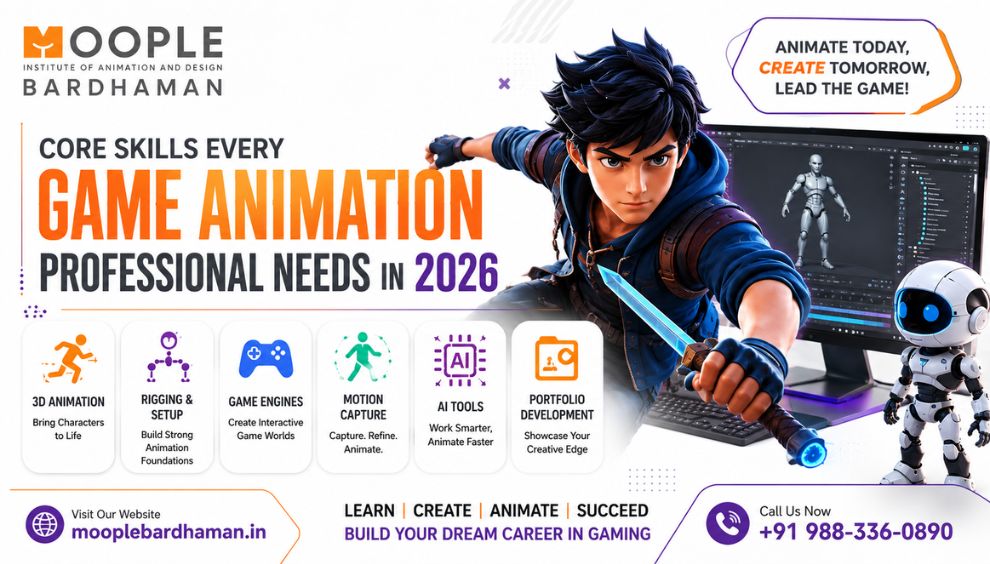
Core Skills Every Game Animation Professional Needs in 2026
The Future of Game Animation Careers Starts Here
The gaming industry is evolving faster than ever. With advancements in artificial intelligence, virtual production, real-time rendering, and immersive gaming experiences, the demand for highly skilled game animation professionals is reaching new heights in 2026.
Whether you're a student after Class 10 or 12, a college student exploring creative career options, or a parent looking for future-ready professions, game animation offers exciting opportunities in game development studios, mobile gaming companies, esports organizations, AR/VR development firms, and entertainment companies worldwide.
Students in Bardhaman are increasingly exploring game animation and game design as career options due to the growing demand for creative professionals in the entertainment and gaming industries. At Moople Bardhaman, one of the leading institutes for Animation, VFX, Game Design, Graphic Design, Web Design, and Digital Marketing training, students gain industry-relevant skills to build successful careers in the creative technology sector.
What Skills Does a Game Animation Professional Need in 2026?
A successful game animation professional in 2026 requires expertise in 3D animation, character rigging, storytelling, game engines like Unity and Unreal Engine, motion capture workflows, AI-assisted animation tools, creative problem-solving, collaboration skills, and a strong portfolio that demonstrates industry-ready game animation projects.
Why Game Animation Is a Promising Career in 2026
The global gaming industry continues to expand across console gaming, mobile gaming, PC games, virtual reality (VR), augmented reality (AR), and immersive digital experiences.
Modern games demand:
Realistic character movement
Cinematic storytelling
Interactive gameplay experiences
High-quality visual effects
Immersive environments
As a result, gaming studios are actively hiring skilled game animators who can bring digital characters and virtual worlds to life.
The increasing popularity of gaming careers has also created a growing demand for quality animation training institutes in Bardhaman, where students can learn professional game development and animation skills.
1. Strong Foundation in 3D Animation
3D animation remains the backbone of modern game development.
Game animators must understand:
Character movement
Body mechanics
Weight and balance
Facial expressions
Acting through animation
Timing and spacing
Players immediately notice when animations feel unnatural. High-quality character movement enhances immersion and gameplay experiences.
Why It Matters
Whether creating a fantasy warrior, sports athlete, racing driver, or action hero, believable movement helps players connect emotionally with the character.
2. Character Rigging Knowledge
Animation and rigging go hand in hand.
Rigging involves creating the digital skeleton that allows characters to move naturally.
Game animators should understand:
Bone structures
Joint systems
Inverse Kinematics (IK)
Forward Kinematics (FK)
Skinning techniques
Character control systems
Even when a dedicated rigger handles the setup, understanding rigging helps animators create smoother and more realistic animations.
3. Storytelling and Character Performance
Animation is not just movement—it's storytelling.
Great game animators understand:
Character emotions
Personality traits
Scene objectives
Narrative flow
Player engagement
A hero preparing for battle, a villain plotting revenge, or a character celebrating victory should communicate emotions clearly through movement.
Industry Trend
Modern story-driven games rely heavily on cinematic animation and performance-based storytelling.
4. Mastery of Game Engines
In 2026, animators are expected to work directly inside game engines.
The two most important platforms are:
Unity
Animators should learn:
Animation blueprints
State machines
Blend trees
Real-time rendering
Animation integration
Gameplay animation systems
Why This Skill Is Essential
Studios increasingly seek professionals who understand both animation creation and game implementation.
5. Motion Capture (MoCap) Understanding
Many AAA and high-end mobile games use motion capture technology.
Motion capture helps create:
Realistic combat scenes
Sports animations
Character performances
Facial expressions
Game animation professionals should understand:
Motion capture pipelines
Data cleanup
Retargeting
Performance enhancement
Motion capture expertise is becoming increasingly valuable across the gaming and entertainment industries.
6. AI-Assisted Animation Workflows
Artificial Intelligence is transforming animation production.
In 2026, animators are using AI tools to:
Speed up repetitive tasks
Generate animation references
Improve workflow efficiency
Assist with motion prediction
Enhance facial animation
Important Note
AI is not replacing game animators.
Instead, it is helping skilled professionals work faster while focusing on creativity, storytelling, and innovation.
Understanding AI-assisted workflows can provide a significant competitive advantage in the industry.
7. Creativity and Artistic Thinking
Technical knowledge alone is not enough.
Successful game animators possess:
Creative vision
Visual storytelling ability
Design thinking
Innovation
Artistic observation
Creative professionals can transform simple concepts into unforgettable gaming experiences.
8. Understanding Human and Animal Anatomy
Great animation comes from understanding how living beings move.
Animators should study:
Human anatomy
Animal locomotion
Muscle movement
Body mechanics
Natural motion
This knowledge helps create realistic characters, creatures, and fantasy beings.
9. Problem-Solving Skills
Game development is a collaborative process.
Animators regularly face challenges such as:
Performance optimization
Technical limitations
Animation bugs
Character movement issues
Gameplay constraints
Strong problem-solving skills help professionals deliver high-quality work while meeting project deadlines.
10. Communication and Team Collaboration
Game development involves multiple departments, including:
Game Designers
Character Artists
Environment Artists
VFX Artists
Programmers
Sound Designers
Animators must communicate effectively with team members to ensure seamless project execution.
Soft Skills That Matter
Teamwork
Communication
Adaptability
Time Management
Professionalism
These skills are often as important as technical expertise.
11. Portfolio Development
A strong portfolio is often more important than a degree.
Employers want to see:
Character animations
Game-ready assets
Gameplay animation sequences
Motion studies
Rigging examples
Real-time engine projects
Portfolio Tips
Include:
✔ Walk Cycles
✔ Run Cycles
✔ Combat Animations
✔ Creature Animations
✔ Cinematic Sequences
✔ Unity or Unreal Engine Projects
Quality always matters more than quantity.
12. Continuous Learning Mindset
The gaming industry changes rapidly.
Successful professionals continuously stay updated with:
- New software
- Industry trends
- AI technologies
- Emerging tools
- Game engine updates
Learning never stops in the world of game animation.
Career Opportunities for Game Animation Professionals
After mastering these skills, professionals can work as:
Game Animator
Character Animator
3D Animator
Motion Capture Artist
Gameplay Animator
Technical Animator
Cinematic Animator
Character Rigger
Animation Supervisor
Game Designer
Industries hiring game animation professionals include:
Gaming Studios
Mobile Game Companies
Animation Studios
AR/VR Companies
Esports Organizations
Entertainment Production Houses
Students pursuing professional animation training in Bardhaman can explore career opportunities not only in India but also in global gaming and entertainment markets.
How Moople Bardhaman Helps Students Build Industry-Ready Skills
As a leading Animation and Game Design Institute in Bardhaman, Moople Bardhaman provides practical training aligned with current industry standards.
Programs focus on:
Animation Fundamentals
3D Animation
Character Design
Game Design
VFX Techniques
Graphic Design
Web Design
Digital Marketing
Portfolio Development
Industry Projects
Students learn through hands-on projects, expert mentorship, software training, and career-focused learning that prepares them for real-world opportunities.
Whether you are searching for an Animation Course in Bardhaman, a Game Design Course in Bardhaman, or professional creative career training after Class 10, Class 12, or graduation, Moople Bardhaman offers structured learning pathways to help students succeed.
Your Next Level Starts with the Right Skills
Every great game begins with an idea, but every memorable gaming experience is brought to life by talented animators. As gaming technology continues to evolve, studios are looking for professionals who can combine creativity, technical expertise, storytelling, and adaptability.
For students in Bardhaman and nearby regions, this is an exciting time to enter the gaming industry. Learning 3D animation, game engines, character rigging, AI-assisted workflows, and portfolio development can unlock opportunities across gaming, animation, AR/VR, and digital entertainment.
The gaming industry doesn't just need players—it needs creators, innovators, and storytellers. The opportunities are growing every year. The real question is whether you're ready to build the skills that can turn your passion for gaming into a rewarding professional career.
FAQs
1. What qualifications are needed to become a game animator in 2026?
Students can start after Class 10, Class 12, or graduation. Professional training in animation, game design, and industry-standard software helps build practical skills and employability.
2. Is game animation a good career option in India?
Yes. India's gaming industry is expanding rapidly, creating strong demand for game animators, technical artists, designers, and creative professionals.
3. Which software should aspiring game animators learn?
Popular tools include Autodesk Maya, Blender, Unity, Unreal Engine, Adobe Photoshop, Substance Painter, and motion capture software used in professional production pipelines.
4. Will AI replace game animators?
No. AI assists with workflow automation and productivity, but creativity, storytelling, artistic judgment, and character performance still require human expertise.
5. What is the difference between game animation and film animation?
Game animation focuses on interactive character movement and gameplay responsiveness, while film animation is designed for linear storytelling without player interaction.
6. How important is a portfolio for game animation jobs?
A portfolio is one of the most important hiring factors. Employers evaluate creativity, animation quality, technical skills, and project experience through portfolio work.
7. What are the highest-paying roles in game animation?
Technical Animator, Animation Lead, Senior Character Animator, Gameplay Animator, Cinematic Animator, and Animation Director are among the most rewarding career paths.
8. Where can students learn game animation in Bardhaman?
Students can join professional animation and game design training programs at Moople Bardhaman, where they receive practical learning, industry exposure, portfolio guidance, and career-focused mentorship.